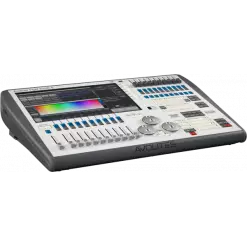
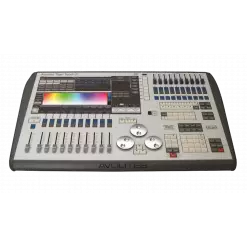
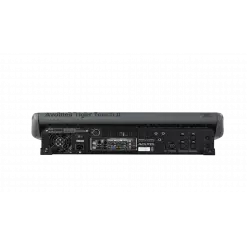
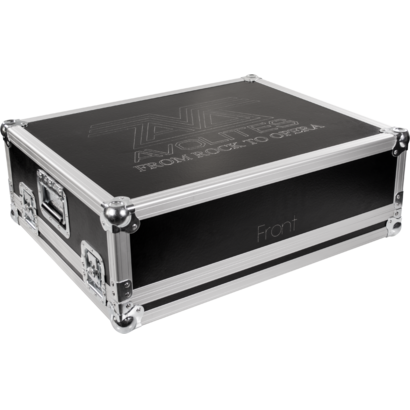
Now boasting a 100% brighter screen, increased processing power, and faster graphics engine, the Tiger Touch II is the most specified Titan console.
The Avolites Tiger Touch II represents the perfect combination of power and portability. This third-generation console is packed with enough power for complex shows, yet small and light enough to fly in standard hold luggage. The console features SMPTE timecode support and a redesigned button layout to match the entire Titan range.
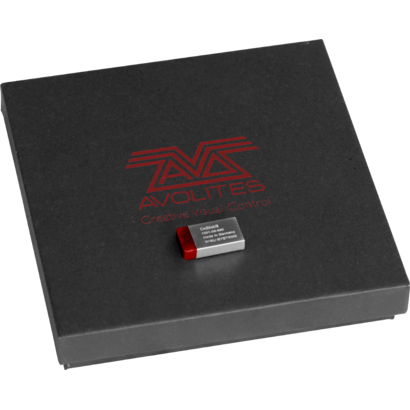
In order to update the console to version 12 of the Titan, it will be necessary to purchase and install a USB dongle called AVOKEY.
Serial 02006 - 03065
You need to order:
- AVOKEYINT
- 1x5 way to USB-A Cable (spare part code 8000-6102)
Once you've received your AVOKEYINT and 1x5 way to USB-A Cable, you will be required to connect the USB-A Cable to the motherboard. This cable will provide an additional USB port for the AvoKey.
Click here to view the installation guide: https://www.avolites.com/Portals/0/Downloads/Manuals/AvoKey/8000-6102 TT2-2-3K AVOKEY upgrade with 1808-0028.pdf
Serial 03066 - 4020
You need to order only AVOKEYINT
Once you've received your AVOKEYINT, you will be required to connect this directly to the available (Blue) USB port inside the console (on the motherboard).
Click here to view the installation guide: https://www.avolites.com/Portals/0/Downloads/Manuals/AvoKey/8000-6101 TT2 AVOKEY no cable.pdf
Serial 04021 - 05001
You need to order only AVOKEYINT
Once you've received your AVOKEYINT, you will be required to connect this directly to the available (Red) USB port inside the console (on the motherboard).
Serial 5001 and above include a factory fitted AvoKey.
Therefore, you do not need to purchase an AvoKey. Simple Visual Basic Programs Examples Pdf
Module Calculator Sub Main() Dim num1 As Double = 10 Dim num2 As Double = 5 Console.WriteLine("Addition: " & num1 + num2) Console.WriteLine("Subtraction: " & num1 - num2) Console.WriteLine("Multiplication: " & num1 * num2) Console.WriteLine("Division: " & num1 / num2) Console.ReadKey() End Sub End Module This program creates a simple guessing game that generates a random number between 1 and 100 and asks the user to guess it.
Here are some simple Visual Basic programs examples that you can use to get started: The “Hello World” program is a classic example of a simple program that prints “Hello World” to the screen. Here is an example of a Hello World program in Visual Basic:
Visual Basic (VB) is a high-level, object-oriented programming language developed by Microsoft. It is a user-friendly language that is widely used for developing Windows applications, games, and other software. VB is an excellent language for beginners to learn programming concepts, and with the help of simple examples, anyone can get started with it. In this article, we will provide you with simple Visual Basic programs examples in PDF format, which you can download and use to learn the basics of VB programming.
[Insert link to PDF]
Module HelloWorld Sub Main() Console.WriteLine("Hello World") Console.ReadKey() End Sub End Module This program creates a simple calculator that takes two numbers as input and performs basic arithmetic operations such as addition, subtraction, multiplication, and division.
In this article, we provided you with simple Visual Basic programs examples that you can use to get started with VB programming. We also included a link to download our simple Visual Basic programs examples PDF, which includes 20 simple programs, code explanations, and example use cases.
Module GuessingGame Sub Main() Dim random As New Random() Dim numberToGuess As Integer = random.Next(1, 101) Dim guess As Integer Console.Write("Guess a number between 1 and 100: ") guess = Console.ReadLine() While guess <> numberToGuess If guess < numberToGuess Then Console.Write("Too low! Guess again: ") Else Console.Write("Too high! Guess again: ") End If guess = Console.ReadLine() End While Console.WriteLine("Congratulations! You guessed the number.") Console.ReadKey() End Sub End Module
Simple Visual Basic Programs Examples Pdf**
Module Calculator Sub Main() Dim num1 As Double = 10 Dim num2 As Double = 5 Console.WriteLine("Addition: " & num1 + num2) Console.WriteLine("Subtraction: " & num1 - num2) Console.WriteLine("Multiplication: " & num1 * num2) Console.WriteLine("Division: " & num1 / num2) Console.ReadKey() End Sub End Module This program creates a simple guessing game that generates a random number between 1 and 100 and asks the user to guess it.
Here are some simple Visual Basic programs examples that you can use to get started: The “Hello World” program is a classic example of a simple program that prints “Hello World” to the screen. Here is an example of a Hello World program in Visual Basic:
Visual Basic (VB) is a high-level, object-oriented programming language developed by Microsoft. It is a user-friendly language that is widely used for developing Windows applications, games, and other software. VB is an excellent language for beginners to learn programming concepts, and with the help of simple examples, anyone can get started with it. In this article, we will provide you with simple Visual Basic programs examples in PDF format, which you can download and use to learn the basics of VB programming.
[Insert link to PDF]
Module HelloWorld Sub Main() Console.WriteLine("Hello World") Console.ReadKey() End Sub End Module This program creates a simple calculator that takes two numbers as input and performs basic arithmetic operations such as addition, subtraction, multiplication, and division.
In this article, we provided you with simple Visual Basic programs examples that you can use to get started with VB programming. We also included a link to download our simple Visual Basic programs examples PDF, which includes 20 simple programs, code explanations, and example use cases.
Module GuessingGame Sub Main() Dim random As New Random() Dim numberToGuess As Integer = random.Next(1, 101) Dim guess As Integer Console.Write("Guess a number between 1 and 100: ") guess = Console.ReadLine() While guess <> numberToGuess If guess < numberToGuess Then Console.Write("Too low! Guess again: ") Else Console.Write("Too high! Guess again: ") End If guess = Console.ReadLine() End While Console.WriteLine("Congratulations! You guessed the number.") Console.ReadKey() End Sub End Module
Simple Visual Basic Programs Examples Pdf**